

Quick Answer: What Is the Emotion Code?
The Emotion Code is a muscle-testing method created by Dr. Bradley Nelson to find and release trapped emotions, stuck energy from past experiences that can affect mood, relationships, and physical pain. A practitioner identifies the emotion using a chart, then releases it with a magnet swiped along your spine.
What’s covered:
- What a trapped emotion actually is
- How a session works, step by step
- What a Heart-Wall is, and how to know if you have one
- What the Emotion Code can help with, including generational patterns
- What the research actually says
- How the Emotion Code compares to the Body Code
- How to find a certified practitioner
You feel it before you can name it. A weight in your chest that has nothing to do with today. A pattern in your relationships that keeps repeating, no matter how well you understand it intellectually.
Dr. Bradley Nelson calls that weight a trapped emotion: stuck energy left over from a moment your body couldn’t fully process at the time. The Emotion Code is the method he built to find one and release it.
This isn’t hands-on energy work like Reiki. It’s diagnostic. A practitioner uses muscle testing to ask your subconscious mind direct questions, narrows down which specific emotion is trapped and roughly when it got stuck, then clears it with a simple magnet pass along your spine.
I went through this process myself, close to a dozen sessions with a Certified Emotion Code Practitioner. What follows covers both the mechanics of how it works and what actually happened when I went through it.

What Is the Emotion Code?
The Emotion Code is an energy-healing method created by retired chiropractor Dr. Bradley Nelson to locate and release what he calls trapped emotions.1 He describes each one as a literal ball of stuck energy, roughly the size of an orange to a cantaloupe, left behind by a moment of emotional stress the body couldn’t fully process.1
That puts it in a different category from touch-based practices like Reiki or Healing Touch. The Emotion Code is technique-based and diagnostic: a structured process for finding a specific block and releasing it, not a general energy transfer.
Lighthouse Insights 💡 What Consciousness Research Reveals About The Emotion Code +
According to ConsciousnessCalibrations.com, Dr. Bradley Nelson’s foundational book The Emotion Code calibrates at 240,5 solidly above the critical level of 200 where force gives way to power, and close to the energy of Healthy itself at 250. His later systems calibrate even higher: The Body Code at 350, the level of Acceptance,5 and The Belief Code at 360.5 That’s a real arc, from releasing emotional charge, to correcting whole-body imbalances, to rewriting the subconscious beliefs underneath both. Most certified practitioners, Linda Armstrong included, hold all three certifications, so working with one person can often carry you through that entire arc.
Calibrations sourced from ConsciousnessCalibrations.com, based on the Map of Consciousness developed by Dr. David R. Hawkins
How Does the Emotion Code Work?
A session moves through three steps: muscle testing, chart identification, and a magnet release.2
Step 1. Muscle testing.
The practitioner uses applied kinesiology to get a yes or no response from your body, often pressing gently on your extended arm while asking a question. A strong muscle response reads as yes, a weaker one as no.
Step 2. Identify the emotion.
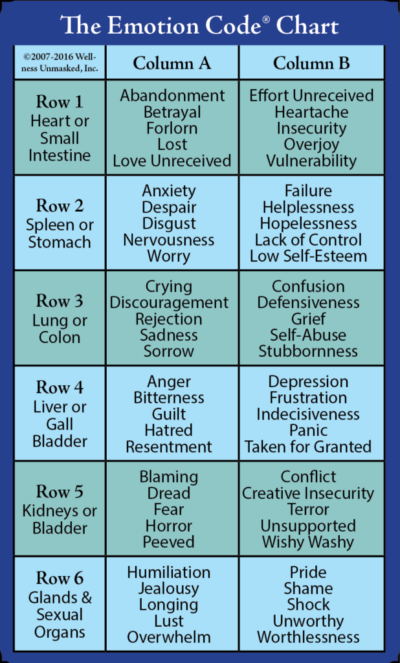
Using the Emotion Code Chart, a list of specific emotions organized in rows and columns, the practitioner narrows down exactly which one is trapped and approximately when it got stuck. [LINK: consider embedding the Emotion Code Chart graphic here, this keyword alone pulls 2,900 searches a month]
Step 3. Release.
Once the trapped emotion is identified, the practitioner runs a magnet along your Governing Meridian, the energy line that runs down the center of your back, while holding the emotion in mind. Practitioners say this is what clears the stuck energy for good.
Here’s what that actually looks like in a session:

What Is a Heart-Wall?
A Heart-Wall is Dr. Nelson’s term for a buildup of trapped emotions that forms a protective barrier around the heart.3 He describes it as a kind of subconscious security system, one that keeps out pain but also keeps out love, desire, and connection.3
My own first Emotion Code session, with a practitioner I found online, started with a Heart-Wall clearing. What stood out was how specific the findings were. The practitioner compared what she found to Rapunzel locked in her tower: a barrier so complete that nothing could get in or out. I hadn’t described anything like that to her. She found it through muscle testing alone.
That session led me to close to a dozen more with Linda Armstrong, roughly weekly at first, then every other week. The biggest findings weren’t just about me. They traced back through generations, patterns visible in my own family, cousins and grandparents included.
A Heart-Wall typically takes two to five sessions to fully clear.3 Linda has walked people through this exact process on video, worth watching before your own first session:
Or listen to the full conversation on the podcast: The Heart-Wall, explained.
A little “good to know”… there’s a 93% chance you have a heart wall. (We are all human after all!?!)

What Can the Emotion Code Help With?
People come to the Emotion Code for four kinds of concerns, and practitioners position it as support for all four, not a cure for any of them.
Emotional.
Anxiety, grief, low self-worth, and a general sense of being stuck without a clear reason why.
Physical.
Dr. Nelson attributes a large share of chronic pain to old emotional charge held in the body.1 That’s his claim, not an independent medical finding, and it’s worth treating it that way: as a practitioner belief, not a diagnosis.
Relational.
A Heart-Wall that blocks giving or receiving love, even in an otherwise healthy relationship.
Generational and ancestral patterns.
This is the part that surprised me most. Dr. Nelson’s work includes the idea that some trapped emotions aren’t originally yours. They can be inherited from a parent at the moment of conception. In my own sessions, patterns showed up that I could trace through my family, well beyond just my own history. It’s a striking idea: that clearing your own trapped emotions might be one real, tangible gift you can give the people who come after you.
One caveat worth stating plainly: if you’re carrying documented trauma, work with a licensed therapist alongside any energy work. The Emotion Code is a complement to that care, not a substitute for it.

What the Research Actually Says
Practitioners and clients report the same thing over and over: specific, consistent findings, session after session, that are hard to explain away as guessing. That was my own experience with Linda. The findings tracked, and they held up over close to a dozen sessions.
The controlled research is more complicated, and it’s worth knowing exactly what it says rather than a simplified version of it. A 2025 systematic review in the Journal of Manipulative and Physiological Therapeutics found manual muscle testing was moderately to very reliable for a handful of specific muscles, when practitioners tested pure strength.4 When testing added the kind of subconscious yes-or-no question the Emotion Code relies on, reliability dropped sharply.4
That’s a real gap between the tool’s strength-testing use and the subconscious-questioning use central to this method. It’s also worth naming why: subjective, subconscious-level work like this is genuinely hard to study with the blinded, controlled methods clinical research relies on. That’s true of a lot of somatic and energy-based practices, not a flaw unique to the Emotion Code.
Here’s the honest bottom line: treat the Emotion Code as a complementary practice, not a diagnostic tool or a medical replacement. Keep your healthcare provider informed of anything you’re doing alongside standard care. Within that frame, plenty of people, myself included, find real, specific value in it.

The Emotion Code vs. the Body Code
The Emotion Code targets specific trapped emotions and Heart-Walls. The Body Code, Dr. Nelson’s Level 2 system, expands the same muscle-testing method to any imbalance in the body, nutritional, structural, toxic, and more.
Most people start with the Emotion Code. It’s the narrower, more approachable entry point, and it’s what most certified practitioners, Linda included, use as the foundation before moving into Body Code and Belief Code work. Read the full breakdown in [LINK: The Body Code post, coming soon].

What to Expect in a Session
Sessions run in person, remotely by phone or video, or by proxy, where the practitioner tests on themselves or a surrogate while thinking of you. Most practitioners, Linda among them, report distance sessions work just as well as in-person ones.
A typical session runs about 20 minutes and addresses five to ten trapped emotions. Give yourself a few quiet days afterward. Most people need that time to process what came up before they notice a real shift.
Here’s an actual session in progress, working through financial blocks specifically:

How to Find a Certified Emotion Code Practitioner
Look for Discover Healing certification, real reviews, and a stated specialty. Certification alone doesn’t guarantee fit. You want someone whose approach and specialty match what you’re actually working on.
My own referral is Linda Armstrong. She’s certified in the Emotion Code, the Body Code, and the Belief Code, which matters more than it might sound like. Most certified practitioners hold all three, so a search on our directory typically surfaces someone equipped to work across all three, not just trapped-emotion release. You can browse [LINK: Linda Armstrong’s directory listing] or watch more of her sessions on video before you book.
For general vetting steps, tools to ask about, questions to bring to a first call, see our full guide: The Ultimate Guide to Finding the Best Energy Healers Near You.
Emotion Code Practitioners
Frequently Asked Questions
Is the Emotion Code the same as EFT Tapping?
No. Both work with the body’s energy system, but EFT Tapping is a self-administered technique where you tap acupressure points while naming a feeling out loud. The Emotion Code is practitioner-led and uses muscle testing to identify a specific trapped emotion, then a magnet to release it. They can be used together, but they’re different tools built for different moments.
Can the Emotion Code help with anxiety or chronic pain?
Practitioners position it as complementary support for both. Clients often report a felt sense of relief after releasing emotions connected to a specific pain area or anxious pattern. It isn’t a diagnosis or a treatment for a medical condition, and it shouldn’t replace care from a licensed provider for either.
Is the Emotion Code scientifically proven?
Not in the way a clinical treatment is proven. Controlled research on the specific muscle-testing method it relies on is thin, and subconscious-level work like this is genuinely difficult to study with blinded methods. What’s better documented is the consistency practitioners and clients describe session to session. Go in treating it as complementary, not diagnostic.
How many sessions does it take to clear a Heart-Wall?
Most practitioners report two to five sessions for a full Heart-Wall clearing, though it varies by person. Broader work, generational patterns, longstanding beliefs, tends to take longer. My own process ran close to a dozen sessions over several months.
Can the Emotion Code address generational or ancestral patterns?
Dr. Nelson’s work includes the concept of inherited trapped emotions, ones passed down from a parent at conception rather than acquired firsthand. Practitioners report finding patterns that trace across a family line. It’s a genuinely striking part of the method and worth asking a practitioner about directly if it interests you.
Ready to Find Out What’s Trapped?
Find a Certified Emotion Code Practitioner.
Many, including Linda Armstrong, are also trained in the Body Code and the Belief Code, so you can go as deep as you need with one person. Start your search here.
Not sure if the Emotion Code is the right fit? Browse all energy healer types and compare approaches before you book.
Emotion Code Practitioners
Sources & Citations
Superscript numbers above correspond to the sources below. All URLs were checked live as of August 25, 2026.
1. Dr. Bradley Nelson: Emotional Baggage, Sports, and Pain
https://drbradleynelson.com/emotional-baggage-sports-and-pain/
Dr. Nelson’s own writing on the trapped-emotions concept, including his description of a trapped emotion’s size and how it forms.
Supports: the definition of a trapped emotion and Dr. Nelson’s claim linking trapped emotions to physical pain.
2. Discover Healing: How Does The Emotion Code Work?
https://discoverhealing.com/emotional-healing-articles/emotion-code-work/
Discover Healing’s official explanation of the three-step Emotion Code process: muscle testing, chart identification, and magnet release.
Supports: the “How Does the Emotion Code Work?” section.
3. Discover Healing: How to Know If You Have a Heart-Wall
https://discoverhealing.com/emotional-healing-articles/how-to-know-if-you-have-a-heart-wall/
Official description of the Heart-Wall concept and how it’s identified through muscle testing and the Emotion Code flowchart.
Supports: the “What Is a Heart-Wall?” section.
4. Journal of Manipulative and Physiological Therapeutics: Systematic Review of Manual Muscle Testing Reliability (2025)
https://pubmed.ncbi.nlm.nih.gov/41236460/
Peer-reviewed systematic review finding manual muscle testing reliability varies by protocol: moderate to very strong for select muscles tested for pure strength, effectively nonexistent when testing adds nonmusculoskeletal (yes/no-style) challenges.
Supports: the “What the Research Actually Says” section, specifically the honest gap between muscle testing’s stronger and weaker use cases.
5. Consciousness Calibrations: The Emotion Code
https://consciousnesscalibrations.com/the-emotion-code/
Map of Consciousness calibration entry for Dr. Bradley Nelson’s book The Emotion Code. Page confirmed live; specific calibration figures sit behind a paid subscription and should be manually reconfirmed before publishing (see checklist).
Supports: the “A Note on Energy” callout box.
6. National Center for Complementary and Integrative Health (NCCIH): Reiki, What You Need To Know
https://www.nccih.nih.gov/health/reiki
Federal government fact sheet on the broader energy-healing evidence base: research quality is generally limited across the category, though no harmful effects have been established.
Supports: the general framing that subjective, subconscious-level and energy-based work is difficult to study with controlled methods, and the complementary-not-diagnostic positioning used throughout.
Discover All of Our Energy Healing Resources
- Types of Energy Healing
- Reiki for Beginners
- Join the 7 Day Challenge! Donna Eden’s Daily Energy Routine
Interested in self-healing or becoming an energy healer? These will help:
- Energy Healer Training: Discover Your Journey to Becoming an Energy Healer
- Exploring Medical Intuitive Training with Caroline Myss: Unlocking Your Potential
- Biofield Tuning Training Course
- Everything You Need to Know About Sound Healing Training
- Explore Energy Healing Tools, Techniques & Practices from Today’s Energy Medicine Pioneers
Discover All of Dr. Bradley Nelson’s Powerful Work Here:
- What is The Emotion Code by Dr. Bradley Nelson?
- What Is The Belief Code?
- Witness an Emotion Code Session: Removing Money Blocks to Financial Abundance
- Unlocking the Power of Emotion Code Training: A Proven Approach to Energy Healing
- Unlock Healing: Inside The Body Code
Leave A Comment