
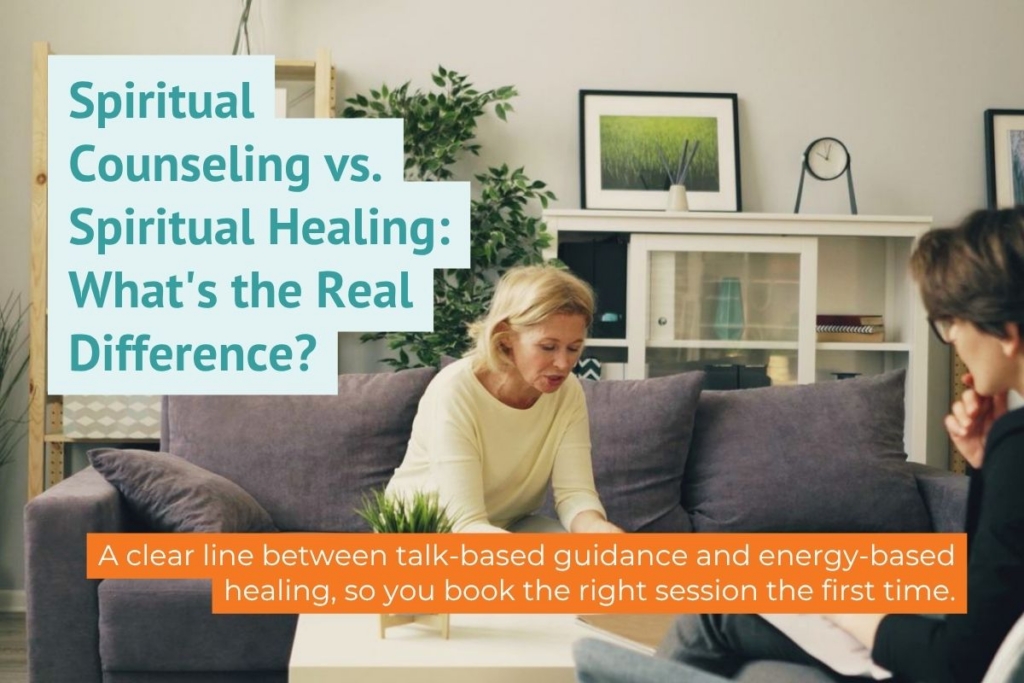
Quick Answer
Spiritual counseling is talk-based dialogue focused on meaning, purpose, and your relationship to something larger than yourself. Spiritual healing is energy-based work, hands-on or hands-off, aimed at a physical or emotional shift. The two overlap often in practice, but the core difference is conversation versus energy work. Neither is a licensed title in the U.S., though one real credential (Board Certified Chaplain) exists nearby for chaplaincy roles specifically.
What’s covered:
- What spiritual counseling actually is, and why even the experts disagree on a definition
- The real difference between spiritual counseling and spiritual healing
- How spiritual counseling compares to therapy, spiritual direction, and coaching
- The one real credential in this space, and why it doesn’t cover this title
- What spiritual counseling cannot do
- A decision framework for choosing the right kind of support
- A directory of spiritual counselors and healers near you
Searching “spiritual counseling” usually means standing at a fork. You know you want spiritual support. You don’t know yet whether that means a conversation or a healing session, a licensed professional or an intuitive guide.
The confusion is real, not yours. Definitions of spiritual counseling genuinely disagree with each other online. Some sources frame it as clinical-adjacent talk therapy. Others describe it as energy work wearing a different name. Then you have spiritual life coaches, you can learn more about this definition here. This guide draws an honest line between spiritual counseling and spiritual healing, shows where the two overlap, and walks through the near neighbors: therapy, spiritual direction, and coaching. Then it covers what credentials actually exist, and which ones don’t cover this title at all, before pointing you toward a directory of practitioners near you.

What Is Spiritual Counseling, Really?
Spiritual counseling has no single agreed-upon definition, and that’s worth naming upfront rather than glossing over.
Two competing versions of the same term.
One version frames spiritual counseling as guided support for meaning, growth, and purpose, distinct from clinical therapy’s focus on symptoms and diagnosis. A more soul-centered version folds in energy systems, intuitive guidance, and karmic themes, overlapping directly with healing-modality language.
Why there’s no standard definition.
One directory-style source states plainly that spiritual counseling lacks a standardized definition, making it difficult to evaluate as a single practice. That’s an honest answer, and it’s more useful than pretending otherwise.
The “fourth dimension of care” framing.
Some practitioners describe spiritual counseling as a fourth dimension of whole-person care, alongside the physical, emotional, and social, aimed specifically at spiritual distress: a disrupted sense of meaning and connection.
The honest answer.
Ask five practitioners what spiritual counseling means and you’ll likely get five different answers. That’s not a flaw in this guide. It’s the actual state of the field, and naming it directly is more useful than a competitor page pretending there’s one tidy definition.

What Is Spiritual Healing (and How Is It Different)?
The core difference between spiritual counseling and spiritual healing is conversation versus energy work.
Spiritual counseling is talk-based.
It’s a guided conversation: dialogue, reflection, values exploration, sometimes prayer or meditation, but fundamentally verbal and relational.
Spiritual healing is energy-based.
A useful consumer framework contrasts psychics, tarot, and mediums, which are informational and about receiving guidance, against energy healers, who “work with the body’s energy system,” where sessions “may involve hands-on or hands-off work, visualization, breathwork” (source). That’s a fundamentally different, largely non-verbal modality aimed at a feeling or energy shift rather than talk-based insight.
Where the two genuinely overlap.
In real-world practice, the line isn’t always clean. Many spiritual counselors also weave in energy healing, intuitive guidance, or meditation, so a single practitioner’s listing might describe both.
If you already know you’re drawn specifically to energy or hands-on healing work rather than conversation, [LINK: see how to find and vet a spiritual healer near you] instead.

Spiritual Counseling vs. Spiritual Direction vs. Therapy vs. Coaching
Five approaches sound similar from the outside but serve different needs, and knowing the difference saves you a wasted first session.
| Approach | Focus | Format | Best For |
|---|---|---|---|
| Therapy | Diagnosable conditions (anxiety, depression, trauma) | Clinical, evidence-based | Symptom relief and mental health treatment |
| Spiritual Counseling | Meaning, purpose, connection to something larger | Guided conversation, sometimes prayer or meditation | Processing a spiritual question outside a clinical frame |
| Spiritual Direction | Discernment within a contemplative tradition | Non-directive, reflective listening | Deepening an existing faith or contemplative practice |
| Life or Spiritual Coaching | Concrete goals and behavior change | Structured, action-oriented | Moving toward a specific outcome |
| Spiritual Healing | Energy shifts, physical or emotional release | Hands-on or hands-off, largely non-verbal | Feeling stuck, blocked, or drained |
Where spiritual direction differs most.
Spiritual direction traces back to contemplative religious traditions and tends to be non-directive by design. Spiritual Directors International, the field’s largest professional body, describes discernment itself as the core of the practice: listening deeply rather than steering the conversation toward an outcome.
A simple rule of thumb.
Choose a licensed counselor or therapist for a diagnosable condition, a life coach for goal-focused growth, and a spiritual counselor or director when the primary need is meaning, purpose, or a relationship to the sacred.

What Credentials Actually Exist for Spiritual Counselors?
One real credential exists near spiritual counseling, but it doesn’t actually cover the title.
Board Certified Chaplain (BCC): the genuinely rigorous one.
The Association of Professional Chaplains, through its affiliate the Board of Chaplaincy Certification Inc. (BCCI), certifies Board Certified Chaplains under real standards: a bachelor’s degree, a 72-semester-hour graduate theological degree from a CHEA-accredited institution, four units of Clinical Pastoral Education, 2,000 hours of supervised chaplaincy work experience, and a current faith-group endorsement, assessed by a peer certification committee (source). An Associate Certified Chaplain tier requires 48 graduate semester hours and two CPE units instead.
Why it doesn’t cover “spiritual counselor.”
BCC certification is specific to chaplaincy roles, typically hospital or hospice-based. It doesn’t extend to independent spiritual counseling practice. In most U.S. states, no license is required to practice spiritual counseling specifically, as long as the practitioner doesn’t present themselves as a licensed clinical professional (source).
Spiritual Directors International: explicitly not a certifying body.
Spiritual Directors International, the largest professional body in the adjacent spiritual direction space, serves more than 6,000 members across 42 countries. It states directly that it does not accredit or certify individual spiritual directors or companions (source). Training-program length in that field varies from two weeks to two or three years, with no standard requirement.
The bottom line.
“Spiritual counselor” is not a licensed or standardized title. The one credential in this neighborhood that’s genuinely rigorous belongs to chaplaincy, not to independent spiritual counseling practice. Optional “spiritual counseling certification” programs exist, but they’re mostly non-standardized add-ons, not a licensing requirement.

What Spiritual Counseling Cannot Do (Scope of Practice)
Spiritual counseling has real limits, and a trustworthy practitioner names them directly instead of letting you assume otherwise.
Not a substitute for therapy or medical care.
Spiritual counseling is not psychotherapy, medical care, or crisis intervention (source). It can complement clinical care. It doesn’t replace it.
Ethical practitioners refer out.
Spiritual counselors should not diagnose mental health disorders, prescribe medication, or treat conditions like major depression or psychosis. When those symptoms show up, an ethical practitioner refers you to a licensed clinician rather than continuing the work themselves (source).
Why this matters most for the spiritual-but-not-religious searcher.
If you’re looking for spiritual support outside a traditional religious frame, you may be carrying something clinical without fully realizing it. A good spiritual counselor recognizes the edge of their own scope and points you toward the right kind of help instead of holding on to the session.

Which One Do You Actually Need? A Quick Decision Framework
Match the support to the actual problem, not the label that sounds closest.
Choose a licensed therapist or counselor
if you’re dealing with a diagnosable condition: depression, anxiety, trauma, or anything that calls for evidence-based clinical treatment.
Choose a spiritual counselor or spiritual director
if your primary need is meaning, purpose, or a sense of connection to something larger than yourself.
Choose an energy healer
if what you’re feeling is more somatic or energetic than something you can talk through: stuck, drained, blocked.
Choose a life coach
if your focus is a concrete goal, not a meaning question.
A short framework built around this exact kind of matching draws the same line: readings and counseling for informational or conversational guidance, energy work for a physical or energetic shift (source). If you already know you need hands-on or energy-based work rather than conversation, [LINK: see how to find and vet a spiritual healer near you] instead. If you want the full picture of every healer type before you narrow down, [LINK: explore every type of spiritual healer] in our companion guide.
A Consciousness Insight 💡 About Choosing Spiritual Progress
Per Brian Gibbs’ Map of Spiritual Progress, spiritual progress calibrates at 510 — the level of Love. It’s the level of the mantra “my destiny is not in my hands,” a surrender of the ego’s need to control the outcome. Choosing between a counselor and a healer isn’t really about landing on the “right” answer — it’s an act of discernment, and that discernment itself is part of what moves you along the path. Trust what resonates.

Why More People Are Searching for This Right Now
More Americans consider themselves spiritual than religious, and that gap is widening.
Spirituality is the norm, not the exception.
Nearly three-quarters of U.S. adults, 74%, describe themselves as at least somewhat spiritual: 32% very spiritual, 42% somewhat. Fifty-eight percent call themselves religious (Pew Research Center).
The searcher this post speaks to directly.
Fifty-three percent of Americans say they’re both spiritual and religious. Twenty-one percent describe themselves as spiritual but not religious, likely the core audience for a search like “spiritual counseling”: people looking for spiritual support outside a traditional pastoral frame (same source).
People are trending more spiritual, not less.
Americans who report becoming more spiritual over their lifetime outnumber those who became less spiritual by roughly four to one (Pew Research Center).
Early outcomes evidence, with an honest caveat.
Research on chaplain and spiritual-care visits shows mixed but generally positive results for patient satisfaction and well-being, including one randomized controlled trial showing reduced depression scores after a spiritual-health consultation (source). That research is chaplaincy-specific, a credentialed, clinical-adjacent role. It isn’t evidence for unlicensed, independent spiritual counselors, and that distinction is worth keeping honest rather than borrowing credibility that doesn’t quite transfer.
Find a Spiritual Counselor or Spiritual Healer Near You
Not sure which one you need? Browse both spiritual counselors and spiritual healers, as well as our spiritual coaches, below and read practitioner profiles to see which approach fits.
Directory of Spiritual Counselors and Healers



Directory of Spiritual Life Coaches



Frequently Asked Questions
Is spiritual counseling a substitute for therapy?
No. Spiritual counseling is not psychotherapy, medical care, or crisis intervention, and a trustworthy practitioner says so directly. It can complement clinical treatment for meaning, purpose, and spiritual questions, but it isn’t equipped to diagnose or treat conditions like depression, anxiety, or trauma. If you’re dealing with a diagnosable condition, start with a licensed therapist or counselor.
What credentials do spiritual counselors have?
Most have none, because “spiritual counselor” isn’t a licensed or standardized title in the U.S. The nearest real credential, Board Certified Chaplain, requires a graduate theological degree, supervised clinical training, and 2,000 hours of chaplaincy experience, but it applies to chaplaincy roles, not independent spiritual counseling practice.
How is spiritual counseling different from spiritual healing?
Spiritual counseling is talk-based: dialogue, reflection, sometimes prayer or meditation. Spiritual healing is energy-based: hands-on or hands-off work aimed at a physical or emotional shift. The two overlap often, since many practitioners blend both, but the core difference is conversation versus energy work.
Is spiritual direction the same as spiritual counseling?
Not quite. Spiritual direction is rooted in contemplative traditions and tends to be non-directive, focused on discernment. Spiritual counseling is typically more active and dialogue-driven. Spiritual Directors International, the field’s largest professional body, is explicit that it does not certify individual spiritual directors, so the same lack of standardization applies here too.
Do I need a license to become a spiritual counselor?
No. In most U.S. states, no license is required to practice spiritual counseling, as long as you don’t present yourself as a licensed clinical professional or provide services that overlap with diagnosable mental health treatment. That’s exactly why vetting a practitioner’s training and ethics matters more than checking for a license.
The Recap
The real difference comes down to this: spiritual counseling is a conversation, spiritual healing is energy work, and the two overlap more often than either side admits.
The credentialing reality is just as clear. Board Certified Chaplain is a genuinely rigorous credential, but it belongs to chaplaincy, not to the open, self-defined title of spiritual counselor. Most of this space, like spiritual healing before it, runs on training you can verify, ethics you can ask about, and your own discernment.
Use the decision framework above to find your starting point. Then [browse spiritual counselors and spiritual healers], or [get listed] if you’re a practitioner ready to be found by people looking for exactly what you offer. Check out our “Best Spiritual Healers” Directory here.
Another great way to Divine a spiritual path is through valid, proven in consciousness, to be of value spiritual readings and reports like Astrology, Akashic Records, and Enneagram reports or personality typing systems found here.
Sources & Citations
Every claim in this guide ties back to a source below. All links open in a new tab and were verified live before publishing.
1. Pew Research Center: Spiritual and Religious Self-Descriptions
https://www.pewresearch.org/religion/2025/02/26/spiritual-and-religious-self-descriptions/
Part of Pew’s 2023-24 Religious Landscape Study, the largest nonpartisan survey of American religious and spiritual identity.
Supports: the 74% spiritual, 58% religious, 53% both, and 21% spiritual-but-not-religious figures.
2. Pew Research Center: Decline of Christianity in the U.S. Has Slowed, May Have Leveled Off
https://www.pewresearch.org/religion/2025/02/26/decline-of-christianity-in-the-us-has-slowed-may-have-leveled-off/
The lead report in Pew’s 2023-24 Religious Landscape Study.
Supports: the roughly four-to-one ratio of Americans becoming more spiritual versus less spiritual over their lifetime.
3. Association of Professional Chaplains / Board of Chaplaincy Certification Inc. (BCCI): Becoming Certified
https://www.apchaplains.org/bcci-site/becoming-certified/
The official certifying body’s requirements for Board Certified Chaplain (BCC) and Associate Certified Chaplain (ACC) credentials.
Supports: the specific education, Clinical Pastoral Education, work-experience, and endorsement requirements for BCC and ACC certification.
4. Spiritual Directors International / SDI Companions: Five Principles of Spiritual Direction Training Programs
https://www.sdicompanions.org/docs/portrait/five_principles_of_spiritual_direction_training_programs.pdf
The field’s largest professional membership body, serving 6,000-plus members across 42 countries.
Supports: the claim that SDI does not accredit or certify individual spiritual directors or companions.
5. CounselingPsychology.org: How to Become a Spiritual Counselor
https://www.counselingpsychology.org/counseling/careers/spiritual-counselor/
A career-guidance resource covering licensing, ethical scope, and the absence of a standardized credential for spiritual counselors.
Supports: the claims that no state license is generally required and that ethical spiritual counselors don’t diagnose or treat clinical conditions.
6. PLOS One: Randomized controlled trial on spiritual health consultation and depression outcomes
https://journals.plos.org/plosone/article?id=10.1371/journal.pone.0313602
Peer-reviewed research on chaplaincy-based spiritual care and depression outcomes.
Supports: the emerging, chaplaincy-specific outcomes evidence discussed in the “Why More People Are Searching” section.
7. SpiriVerse: Tarot, Psychic, Medium, or Healer: Which Spiritual Service Do You Need?
https://www.spiriverse.com/blog/choosing-between-spiritual-modalities
A practitioner directory’s consumer-facing decision framework for choosing between spiritual services.
Supports: the description of energy healing as hands-on or hands-off, non-verbal work, and the decision-framework logic used in this guide.
8. Inner Quest Foundation: Healing Through Spiritual Counselling
https://innerquestfoundation.com/healing-spiritual-counselling/
An education-focused nonprofit’s overview of spiritual counseling’s scope and ethical boundaries.
Supports: the scope-of-practice statement that spiritual counseling is not psychotherapy, medical care, or crisis intervention.
Note: several third-party “market research” aggregator sites surfaced large global spiritual-services market-size figures during research. These were excluded as citations because their specific dollar figures could not be verified against a primary economic source, per your brief’s own recommendation.


Leave A Comment